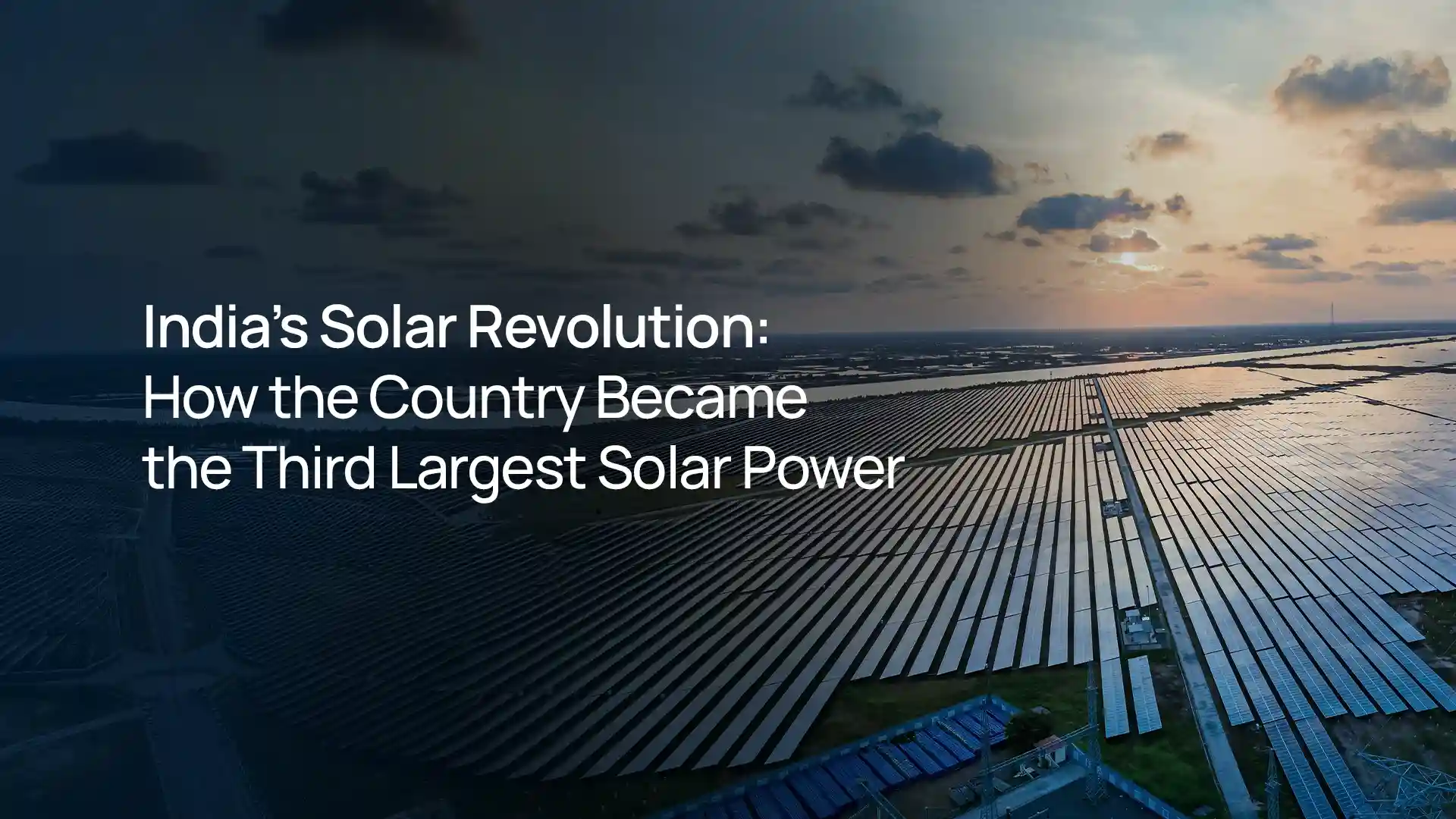
Fourteen years after launching its first national renewable investment program, India became the world’s third-largest solar power producer in 2024. That year, the country officially produced more electricity from solar energy than Japan for the first time, being surpassed only by China and the United States.
In January 2025, India's installed solar capacity exceeded 100 gigawatts. To put this into perspective, in March 2014, the country had 2.82 GW of solar capacity.
Today, it has over 132 GW – an almost 4,700% increase in just 11 years.
This is due to strong government policies, falling technology costs, ambitious national goals, and, of course, investment in renewable energy – all of which have had a positive effect. But let’s unpack this impressive achievement.
Based on data from IRENA Renewable Energy Statistics 2025, India stands:
- 3rd in solar energy
- 4th in wind energy
- 4th globally in total installed renewable energy capacity
Top countries by solar power capacity:
Why solar power has become so important for India
According to the Ministry of New and Renewable Energy, the majority of the country's terrain receives 4 to 7 kilowatt-hours of solar radiation per square meter every day which is considered to be a very good to excellent level. Therefore, taking advantage of this became imperative.
Where it began: The National Solar Mission
The starting point of India’s journey towards becoming a solar power can be considered to be January 11, 2010 when India’s Prime Minister Manmohan Singh launched the Jawaharlal Nehru National Solar Mission.
Naturally, compared to today’s standards, the target established was rather modest – installing 20 GW of grid-connected solar capacity by 2022.
At that time, solar tariffs were anything but low, while coal was cheap since the grid had been developed, and most investors were sceptical about the solar project.
How did India promote investment in solar energy?
The Solar Mission involved creating a procurement infrastructure before there was any demand on the market.
The Indian government set up a clear and organized system for buying solar power so that private companies were actually motivated to invest.
Let's say a government wants a construction company to build apartments. Instead of stating "we'd love more housing", the government needs to provide land, contracts, and a clear price per unit, which is exactly what India did with solar energy.
Reverse auctions for bidders
The government announced how much solar power the country needed, and companies competed to win the contract by offering the lowest price. Whoever pledged to sell electricity at the cheapest rate won the deal. This reverse auction system quickly drove prices down.
Power purchase agreements
There was a guaranteed contract, a Power Purchase Agreement, that stated "we will buy your electricity for X years at a fixed price."
State-level solar parks
The government prepared substantial areas and plots of land where grid connections had already been installed so developers did not need to spend years looking for land and navigating bureaucracy.
Put together
As soon as the country had created a predictable pipeline, which included prepared land, contract standards, and a competitive process, solar became a safe bet, and private companies started to invest.
How has the price drop changed things?
While policy set the stage, cost was the real driver, with solar tariffs in India having fallen from ₹119 (~US$0.39) per unit (1 unit = 1 kilowatt-hour) in 2010 to around ₹2.15 (~US$0.023) per unit.
Three things have driven the price reduction:
● An internal competitive bidding system whereby companies had to bid against each other to win solar contracts, and whoever managed to provide the lowest price for electricity won.
● The proximity of Chinese manufacturing units, which made solar panels much cheaper.
● More successful solar projects lowered financing costs because the sector had proved itself to be bankable.
Simultaneously, solar PV module production capacity registered a rapid growth, hitting 1,150 GW by the end of 2023 and expected to reach 1,600 GW by 2030.
Domestic manufacturing of solar cells and panels
Throughout the last decade, India’s dramatic growth in solar energy relied on imported Chinese panels which rightfully concerned policymakers in terms of energy security.
That concern led to the introduction in 2021 of the Production-Linked Incentive (PLI) scheme, which aimed to address this issue via subsidies for domestic module manufacturing.
Solar modules (solar panels)
As a result, the nation’s solar module manufacturing capacity nearly doubled in just a year, from around 38 GW annually in March 2024 to 74 GW in March 2025.
In 2025, the country added another 81 GW of module manufacturing capacity bringing the total capacity to 144 GW per year.
Solar PV cells
Solar cell production is newer, with around 25 GW of cell capacity being included on India's Approved List of Models and Manufacturers, which the government unveiled in mid-2025.
Check out this solar cell manufacturing facility and how it works:
The future of solar power in India
India plans to reach 500 GW of green fuel capacity by the end of this decade.
If the nation maintains its current pace of adding around 50 GW of renewable energy annually, that goal looks pretty much achievable, but only if grid infrastructure scales in parallel with power generation.
In addition, the country aims to reach net-zero emissions by 2070.
The graph below shows India’s expected annual solar manufacturing capacity by solar component (in GW)
Manufacturing capacity is expected to register further growth by at least the end of the decade.
In terms of solar power, several steps are being taken, according to India’s Ministry of Power:
- Large-scale solar parks and ultra mega solar projects are being established to offer land and grid access to developers.
- A Production Linked Incentive (PLI) scheme is considerably increasing the production of high-efficiency solar panels within the nation’s borders.
- Schemes like PM Surya Ghar (free rooftop solar panels for homes) are becoming more accessible to all citizens.
- In order to store solar energy for use at night or on cloudy days, battery storage is being rapidly expanded; in 2025, 30 GWh of additional capacity was approved.
- Transmission waivers and a Green Energy Corridor* are being employed to reduce the cost and ease of moving solar power across state lines.
* When solar energy is produced in one state such as sunny Rajasthan, and it has to be transmitted to another state, it goes via power lines with companies generally having to pay a fee to use those lines.
- Transmission waivers mean that the government waives those fees so that it costs less to transport green energy.
- Green Energy Corridor refers to the government building new power lines to carry that renewable energy.
All in all, this means that solar power can travel farther, faster, and at a lower cost, which in turn encourages more companies to build solar plants and more states to use solar energy.
Final word
India's solar power path demonstrates how carefully planned policies, technological innovation, and strategic partnerships can revolutionize a country's energy landscape.
Solar power has become the backbone of the country’s green energy mix, and a force that facilitates sustainable economic development and, most importantly, helps to improve energy security.