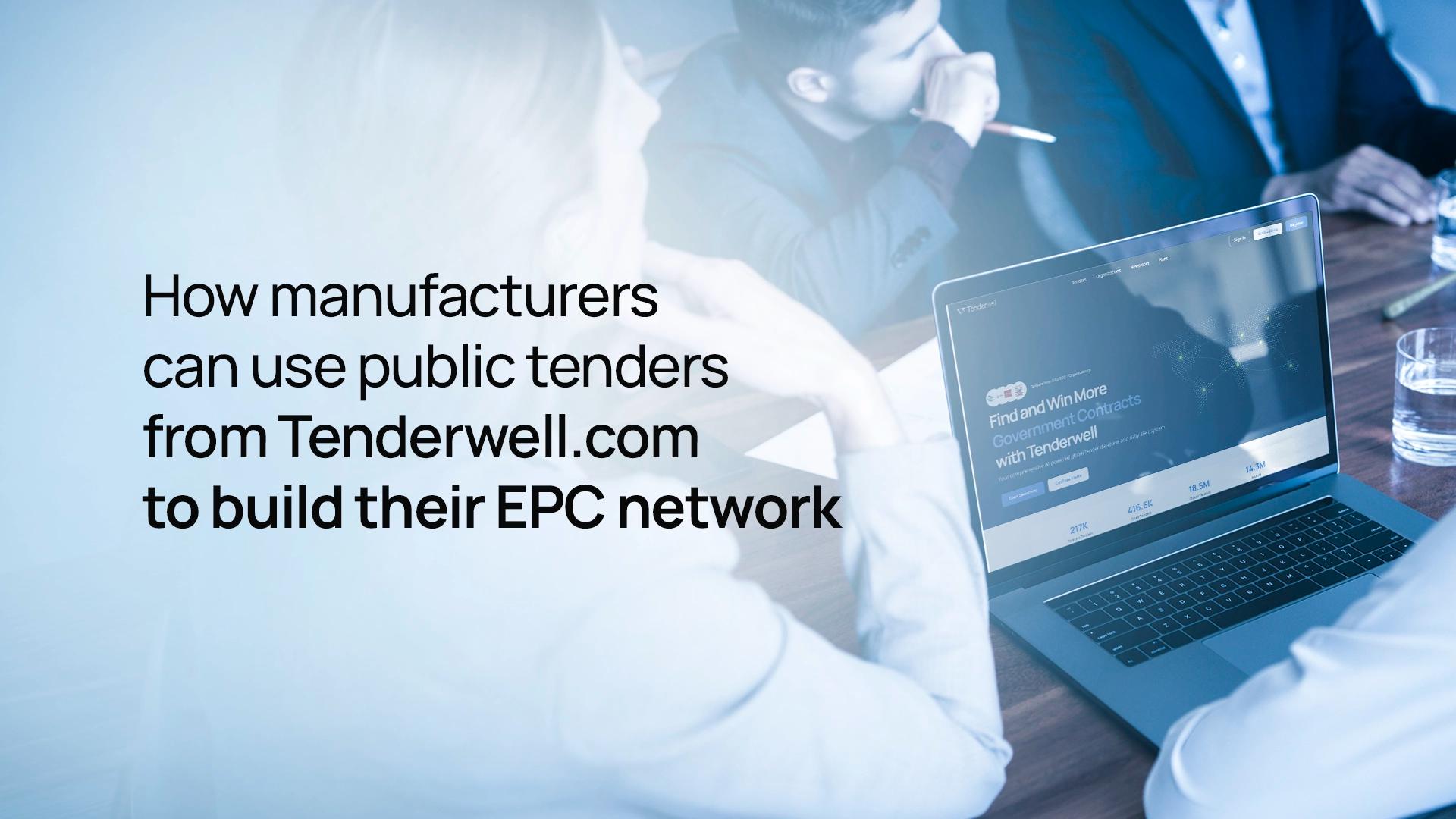
Ignoring business intelligence tools like Tenderwell.com is like dismissing a tool because it doesn’t pay off instantly, even though it’s designed to uncover opportunities you’d never see otherwise. Since the companies actually submitting bids are Engineering, Procurement, and Construction (EPC) firms, the very customers you want, tracking awarded tenders becomes a way to see which EPCs are actively pursuing projects in your sector.
That insight lets you reach out early, while scopes are still being defined, instead of showing up after they’ve already selected their suppliers for the next tender.
Here’s an example:
When a government commissions a new solar power plant, various engineering and construction firms may compete for the EPC contract.
If an international renewable‑energy contractor wins, they take full responsibility for Engineering, Procurement, and Construction of the facility.
The EPC contractor handles the entire project by designing the solar plant, procuring key components like panels, inverters, and transformers from specialized manufacturers, and serving as the sole tender participant and primary contact for the government; these manufacturers do not engage directly in the tender.
With that entire delivery chain in mind, let’s now look at how you can leverage the awarded tender data from Tenderwell.com:
How can Tenderwell.com help you find EPC partners
Using Tenderwell, you can:
- Track which EPCs firms are winning major projects. This helps you spot the right partners.
- Access historical data on past tenders and see what governments have paid previously. Thus, you can benchmark pricing and calculate budgets for new bids.
- Get alerts just when a relevant project is announced. This is because at Tenderwell, we keep track of thousands of public portals around the world.
Check out the screenshots below to get a better idea of how Tenderwell might be beneficial for you:
1. AWARDED tenders for benchmarking.
While open tenders show you what’s happening in the market right now, awarded tenders give you deeper insight into market dynamics.
- Who is winning (evaluate your competitors)
- At what prices are contracts being awarded?
- How long do suppliers retain contracts?
- What evaluation do the criteria buyers value?
- What solutions or configurations are being accepted?
- Search by keywords relevant to your category: "grid storage," "inverter supply," "solar installation". Plus, consider filtering by region.
- Search for awarded tenders, instead of open.
2. Build your own map
You’re likely hunting for several EPCs. This means that you need to know several things: Which firms keep showing up? In which countries? At what project size?
After carrying out a few searches, you will notice a picture starting to appear of who actually controls project execution in your target markets.
3. Analyze the values of each contract
Check out historical pricing data. It tells you what governments have actually paid (note: not what they budgeted, and not what was estimated). You can walk into an EPC conversation knowing what the end-client is likely to spend, which makes you a much more credible supplier partner.
Review historical pricing data to see what governments have actually paid, not just budgeted or estimated. That knowledge lets you walk into EPC conversations with a realistic sense of the end client’s spending.
4. Research the EPC before reaching out.
Before you approach an EPC, pull their full tendering history. Are they growing? Are they active in markets that matter to you? Have they won projects that needed your exact product category? A quick check here changes the whole approach.
5. Reach out (but with context).
This is where the work pays off. Instead of a generic introduction, you can say: "We noticed you've won three grid storage projects in Southeast Asia over the past 18 months. Here's why our inverters tend to be a good fit for that project type."
A case study that explains why this approach works
A global leading provider of all-scenario solar and energy storage solutions recently went through this process.
The company did not wait for EPC relationships to develop organically (this process can take years). The provider used awarded tender data from Tenderwell.com to see which firms were actively winning large-scale energy projects.
Then, the company approached these firms directly.
Remember:
Tenderwell.com monitors public procurement portals across 180 countries and puts awarded tenders, contract values, and winner profiles in one place. If you want to see how it works for your sector, feel free to reach out or drop a question below.
Curious how this could work for your sector? Reach out directly at Tenderwell.com/contact